In this guide
- What your mouth does when you say a name
- Consonants and the feel they tend to give
- Vowels and the color they add
- The bouba and kiki idea, honestly stated
- Syllable count and rhythm
- Ending sounds change how a name lands
- A quick table of sound features and typical feel
- How to test a name by saying it aloud
- Matching sound to genre and mood
- Readability across languages and accents
- Accessibility: names that tools and ears handle badly
- Practical exercises to train your ear
- Common mistakes to avoid
- Frequently asked questions
- Conclusion
Key takeaways
- Hard stops like k, t, and p tend to feel sharp, while l, m, and n tend to feel smooth
- Syllable count and stress set the rhythm of a name
- Always say a name aloud before you commit to it
- Check how voice chat and screen readers handle it
Names feel strong, soft, or friendly mostly because of the sounds inside them and the rhythm those sounds make. Short bursts like k, t, and p tend to feel sharp and fast. Hums and glides like m, n, and l tend to feel smooth and warm. None of this is a rule, but once you can hear the pattern, you can pick or build a name that sounds the way you want it to.
You do not need training in language science to do this. You only need your own mouth and ears. This guide explains what is happening when you say a name, what tendencies are worth knowing, and how to test a name before you settle on it. It also covers some practical issues that people forget, like how a name sounds over a noisy voice chat or how a screen reader reads it.
What your mouth does when you say a name
Every sound you make is a small physical action. Some sounds stop the air. Some let it flow. Some buzz in your nose. The feel of a name comes partly from which actions it asks your mouth to perform, and in what order.
Say "kit" slowly. Your tongue touches the roof of your mouth, air builds up, and then it pops out. Now say "moon." Your lips close and hum, then the sound rolls out through an open vowel and ends with a hum in your nose. The first word is a tap. The second is a slide. Most people, if asked, would call the first one quicker and the second one gentler, even though both are just single syllables.
Here are the main sound groups and what they ask of your mouth.
- Stops (p, b, t, d, k, g). The air is blocked for a moment, then released. They sound crisp and percussive. Some of them, like p, t, and k, are "voiceless," which means your voice box is quiet during them. The voiced ones, b, d, and g, add a little buzz and feel a bit rounder.
- Fricatives (f, v, s, z, sh, th). Air squeezes through a narrow gap and makes a hiss or a buzz. They feel airy, sharp, or slippery depending on the sound.
- Nasals (m, n, ng). The sound goes out through your nose. They hum, and they tend to feel warm and connected.
- Liquids and glides (l, r, w, y). The tongue or lips move smoothly with no hard stop. They feel flowing and light.
- Vowels (a, e, i, o, u and their many sounds). These are open sounds. Where your tongue sits and how round your lips are changes the color a lot.
A name is a string of these actions. A name full of stops feels like tapping a table. A name full of nasals and liquids feels like humming. A name that mixes them feels like a short tune with a beat and a tail.
Consonants and the feel they tend to give
Stops are the sharpest tools in the box. Think of invented names like Kryptak, Taskor, or Pikt. The hard k and t sounds make them feel quick, cold, and a bit aggressive. That is why a lot of fierce clan names lean on them. They land with a click.
Now think of Lumari, Noelle, or Mino. The l, m, and n sounds keep the air moving. There is no click anywhere. Those names tend to feel calm, soft, or friendly. A nickname for a close friend often drifts this way without anyone planning it. "Mimi" and "Nana" are easy examples of this habit.
Fricatives sit in the middle and can go either way. A long s or sh sound can feel hushed and sneaky, like in "Shisa" or "Sable." A sharp f or v can feel energetic, like in "Vex" or "Fenn." The z sound often feels buzzy and playful, as in "Zozo" or "Zipp."
The letter r deserves a note. In many accents of American English it is a smooth, growly glide. It can add weight and grit to a name, like in "Grom" or "Raven," without the snap of a stop. In other accents it behaves differently, so what you hear may not match what a listener from another region hears.
Voiced versus voiceless
Compare "Pat" with "Bad." Both have a stop at each end, but the first uses only voiceless stops and the second uses voiced ones. Many people hear the voiced pair as heavier and slower, and the voiceless pair as lighter and snappier. This is a small effect, and it is easy to lose once other sounds enter the mix, but it is a good thing to notice when you are choosing between two close spellings, like Kade and Gade.
Vowels and the color they add
If consonants set the texture of a name, vowels set the color. Roughly speaking, vowels made at the front of the mouth with a smile-like shape, such as the "ee" in "see" or the "i" in "kit," tend to sound small, bright, and quick. Vowels made at the back with rounded lips, such as the "oo" in "moon" or the "o" in "bold," tend to sound bigger, deeper, and slower.
You can test this on yourself. Say "Tizzi" and then "Toomo." Most people feel that the first is tiny and zippy and the second is large and slow. Add a hard stop and you get something else again. "Tikki" is tiny and sharp. "Tonk" is heavy and blunt.
The open "ah" sound, as in "father," sits in the middle. It is wide and friendly. Names like "Ava," "Sana," and "Kaza" use it a lot. A long "oh" feels round and gentle, as in "Noah" or "Rolo." A short "uh" can feel plain or earthy, as in "Dunn" or "Bud."
These are tendencies, not laws. A name like "Kiki" has a bright vowel and sharp stops, so it feels tiny and bouncy. A name like "Oolon" has two round vowels and a nasal at the end, so it feels deep and slow. You can mix the two groups on purpose to create tension, such as a sharp consonant with a deep vowel: "Torgul." It sounds like something that bites but is also quite big.
The bouba and kiki idea, honestly stated
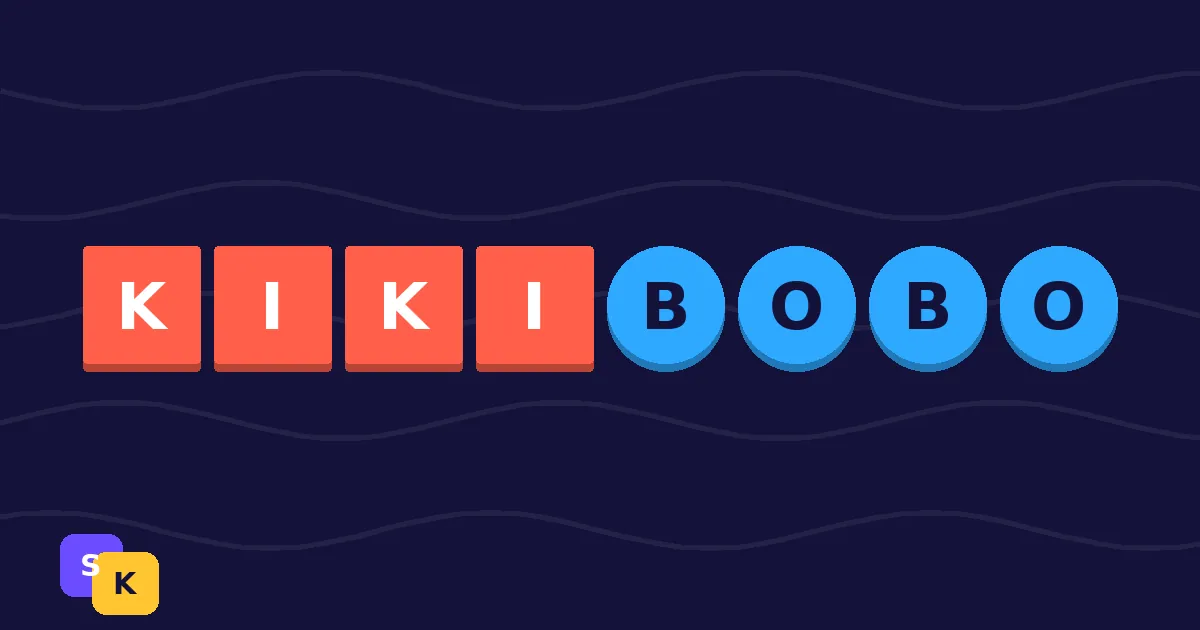
You may have heard of the "bouba/kiki effect." In some experiments, people were shown a rounded, blobby shape and a spiky, jagged shape and were asked which one was called "bouba" and which was called "kiki." Many participants matched "bouba" to the round shape and "kiki" to the spiky one. Versions of this test have been tried with different groups of people and different made-up words.
That is a neat finding, and it fits the pattern in this article. Rounded vowels and soft consonants lined up with round things. Bright vowels and hard stops lined up with sharp things. But it is worth being careful about how much weight to put on it.
- It was tested on made-up words and simple shapes, not on real names and real people.
- Results varied between studies and between groups, and the effect is usually described as a tendency, not something everyone does.
- Culture, language, and spelling can shift how people hear a word. A person who reads "bouba" in a different spelling system may not hear what you expect.
- It says little about whether a name is good. It only suggests that certain sound patterns often pair with certain impressions.
The practical takeaway is modest. If you want a name to feel spiky, using spiky sounds is a reasonable bet. If you want a name to feel round, use round sounds. Then check with real listeners, because your own ear is one sample and the people who will say the name are the ones that matter.
Syllable count and rhythm
Sound is not only about which letters you use. It is also about how many beats the name has and how they are spaced.
One-syllable names hit like a single drum beat. "Kade," "Rue," "Zane," and "Mox" are quick, compact, and easy to shout. They suit fast games and short chat messages. The downside is that a lot of one-syllable names are already taken, so you may end up adding numbers or symbols.
Two-syllable names have a natural back-and-forth, like a heartbeat. "Ravi," "Mina," "Taskor," and "Lumi" all fit here. This is the most common length for personal names and for nicknames, and it is the easiest to remember. If you are unsure, start here.
Three-syllable names feel more flowing and more formal. "Alinor," "Sanari," and "Kazimo" take a bit more breath. They can sound elegant or epic, but they are slower to say and easier to shorten into something else. If your three-syllable name is likely to be shortened by others anyway, pick the short form yourself.
Four or more syllables are hard to carry in speech. Unless the name is meant to be grand, such as a long-running story character, it tends to get cut down. A team member who has to say "Thundermaw Lorekeepers" fifty times in a night will start saying "Thunder" or "Lore."
Stress and where the beat falls
In English, stress is the louder, longer beat in a word. Many two-syllable English names put the stress on the first syllable, as in "LU-mi" or "TAS-kor." That often sounds firm and settled. Putting the stress on the second syllable, as in "ra-VEEN" or "ka-ZAR," tends to sound more dramatic or foreign to many English speakers, and it can also feel like the name is leaning forward.
Stress also changes how a name feels when other people say it. If the stress is not obvious from the spelling, listeners will guess. "Anila" could be "a-NEE-la" or "AN-i-la." If you care, pick spellings that make it clear, or be ready to say it once and let it stick.
Rhythm matters inside a name too. Compare "Kitakoto," which is a string of equal beats like a drum roll, with "Kitoma," which has a natural lilt. Even beats feel mechanical or playful. A lilt feels like a person.
Ending sounds change how a name lands
The last sound is the one people remember, so it carries a lot of weight. Think of it as the way a name closes its door.
- Ending on a hard stop (k, t, p, d, g) makes a name feel finished and firm. "Vorak," "Dret," and "Kip" end like a click.
- Ending on a nasal (m, n) makes it hum out. "Lumin," "Soren," and "Mim" fade softly.
- Ending on a vowel leaves the sound open. "Mina," "Rolo," and "Sanu" feel friendly, and a final "a" or "o" is a common pattern in nicknames.
- Ending on an "ee" sound feels cute and quick, like "Tippy," "Mimi," or "Zozi." This is the classic nickname ending in English.
- Ending on s or z makes a name hiss out, such as "Vexes" or "Kaz." Ending on a plural-like s can also make a name read as a group, which is handy for teams.
A tiny edit to the ending can flip the mood. Take the invented name "Rovik." It ends on a stop, so it feels hard. Change it to "Rovi" and it softens. Change it to "Rovy" and it turns playful. Same start, three different feelings.
A quick table of sound features and typical feel
Here is a summary you can keep nearby. Read it as a list of tendencies. Real names mix many features, and context changes the effect.
| Sound feature | Examples | Typical feel | Where it often fits |
|---|---|---|---|
| Voiceless stops (k, t, p) | Kryptak, Pikt, Taskor | Sharp, fast, tough | Fierce clans, action games, short tags |
| Voiced stops (b, d, g) | Brogan, Dag, Gorb | Heavy, blunt, solid | Tanks, bruisers, dependable characters |
| Nasals (m, n) | Mino, Lumen, Noni | Warm, humming, friendly | Cozy nicknames, pets, calm servers |
| Liquids (l, r) | Lira, Orel, Rolo | Flowing, light or gritty | Fantasy, elegant or gentle names |
| Hissing sounds (s, sh, z) | Sable, Shisa, Zipp | Airy, sly, buzzy | Stealth, playful, mysterious names |
| Front vowels (ee, i) | Tizzi, Kip, Mimi | Small, bright, quick | Cute or speedy names |
| Back vowels (oo, o) | Toomo, Bolt, Orum | Big, deep, slow | Strong, large, or calm names |
| Open "ah" | Ava, Kaza, Sana | Wide, friendly | Personal names, welcoming groups |
| One syllable | Kade, Rue, Mox | Compact, punchy | Handles, tags, shouted callouts |
| Three or more syllables | Alinor, Sanari | Flowing, formal, epic | Story characters, long-term projects |
| Ending in "ee" or "o" | Tippy, Rolo | Cute, relaxed | Nicknames, mascots |
| Ending in a hard stop | Vorak, Dret | Final, firm | Clan names, rivals, bosses |
How to test a name by saying it aloud
A name that looks good on a screen can feel awkward in a mouth. Testing takes a few minutes and saves a lot of regret. Use the steps below.
- Say it three times, alone. Speak it at normal speed, not in a whisper. If your tongue trips anywhere, mark that spot. A trip usually means two sounds are too close together, like "Strixtor."
- Say it in a sentence. Try "Hey, Kazimo, you there?" and "Kazimo got the last point." A name has to work inside speech, not just alone.
- Shout it. If it is a team or callout name, say it fast and loud. Short stops carry well. Soft hums can vanish.
- Ask someone to spell it after hearing it. Say it once and have a friend type what they heard. If they write something very different, think about a clearer spelling.
- Ask a different person to say it after reading it. This tests the other direction. If they stress the wrong syllable or guess a different vowel, you now know what other people will do.
- Listen for accidental words. Run the name together with common words that might come before or after it. Check that it does not sound like something rude or silly.
If you are building a name from pieces, a blending tool can give you a pile of candidates to run through this test. The Name Mixer blends two names into combined options, and you can pick the ones that pass the mouth test. If you want to understand the blending methods themselves, how to mix two names walks through seven simple ones.
Matching sound to genre and mood
The same feature that suits one setting can ruin another. A name has to fit where it lives.
A fierce clan name
Leans on voiceless stops, short vowels, and firm endings. Think "Krael Vortak" or "Dread Pikt." Two beats or one, strong first-syllable stress, and an ending that closes with a click. The sound says "fast, tough, serious."
A cozy nickname
Leans on nasals, liquids, open vowels, and an "ee" or "o" ending. Think "Mimo," "Lulu," or "Nono." The sound says "close, safe, familiar." It is made to be said gently by someone who knows you.
Many names sit between these two. A friendly gaming team might want a name that feels strong but not scary, like "Bold Mango" or "Rolo Squad." Notice the mix: round vowels and a soft nasal with one hard stop for energy.
Here are a few invented examples sorted by feel, so you can hear the contrast.
- Krael
- Vortak
- Pikt
- Drexa
- Taskor
The five above are sharp. They lean on stops and short vowels.
- Lumari
- Noelle
- Mino
- Solane
- Oreli
These five are soft. They lean on nasals, liquids, and open vowels.
- Bolo
- Kimmi
- Rafu
- Tavi
- Zeno
And these five are mixed, with one crisp sound and a friendly vowel or ending. They tend to suit casual groups and playful handles.
If you are building a team name and want sharper or tougher options to try, the Clan Name Generator is a quick way to see lots of candidates. Then use the sound features in the table above to decide which ones match your group. For help with the choosing part, how to choose a clan name covers how to get a whole team to agree.
Readability across languages and accents
A name that sounds great in your accent may sound different, or be hard to say, for someone else. If your community is international, this matters.
Some sounds are not shared across languages. The English "th" in "think" is difficult for many learners, and the English "r" is made differently in many languages. A clan name like "Thrathor" asks a lot of non-native speakers. A name like "Tasko" does not.
Consonant clusters, which are two or three consonants in a row, are another trouble spot. "Strix" and "Kryst" are fine for many English speakers. They can be hard for people whose languages usually put a vowel between consonants. If you want broad readability, put vowels between your consonants. "Strix" becomes "Sitrix" or "Strixa" if needed, though you may find the original sounds better. It is a trade.
Spelling also matters. Letters like c, g, and j are said differently across languages. A "c" can be a "k" or an "s" depending on the next letter and the language. A "j" may be said like "y" or like "zh." If you want people to say your name the way you hear it, use the plainest spelling that gets there. "Kazimo" is easier to read worldwide than "Cazimo."
Finally, check for accidental meanings. A short invented word can mean something unexpected in another language. You cannot check every language, but you can do a quick web search of the name and see what comes up. Our name availability checklist includes that search as a step.
Accessibility: names that tools and ears handle badly
A name is also read by software and heard through bad speakers. Thinking about this early makes your name friendlier to everyone, including people who use screen readers or who play with a noisy headset.
Screen readers
Screen readers read text out loud. They do their best, but they are literal. Several habits make names hard to hear.
- All lowercase run-together words. "darkmoonwolf" may be read as a jumble. Capitalizing each word, as in "DarkMoonWolf," often helps the reader split it correctly. Many readers handle this well, though not all.
- Numbers swapped for letters. A name like "K1ng" may be read as "K, one, ng." The same goes for "N00b" and similar. The result sounds nothing like what you meant.
- Lots of symbols. Underscores, stars, and dots may be read out loud as "underscore" or "star," or skipped, depending on settings. A name with six symbols can become a long, strange phrase.
- Decorative letters. Fancy Unicode letters that look like regular letters can be read as their formal descriptions, such as "mathematical bold small k." This can be painful to listen to.
- Emoji. They are usually read by their descriptive names, so a name with three emoji can become a long spoken list.
Voice chat and noisy rooms
When a name is spoken over a compressed microphone, some sounds blur. The pairs "b" and "p," "m" and "n," "f" and "s," and "d" and "t" are especially easy to mix up. If your name has to be clear on a bad connection, avoid depending on one of those distinctions. "Bim" may be heard as "Pim" or "Bin," while "Kazimo" is more distinct because it has more different sounds.
Names that sound like common words are also tricky. If your name sounds like "Hey" or "Okay" or "Go," other players may think you are talking to them. And names with look-alike spellings, like a capital I and a lowercase l, are impossible to tell apart when read aloud, so make sure the spoken version carries the identity.
Practical exercises to train your ear
You can get better at hearing sound feel in about a week of casual practice. These exercises take only a few minutes each.
- Sort a list. Write twenty names, real friends or invented ones, on paper. Sort them into "sharp," "soft," and "mixed." Compare your sorting with a friend's. Where you disagree is where the feel is personal.
- Swap one sound. Take a name like "Mina." Change the first sound to get "Tina," "Kina," "Lina," and "Gina." Say each one. Notice how the first sound shifts the mood.
- Change only the ending. Take "Vorak" and try "Vora," "Vori," "Voram," and "Vorak." Say them one after another. This shows how much work the final sound does.
- Rebuild a name for a different mood. Take a cozy nickname like "Nonu" and rebuild it as a clan name, such as "Nokrut." Then reverse it. This forces you to think about which sounds carry which mood.
- Run the mouth test on blends. Use a few blended names from a generator and say each aloud. Keep only the ones that feel good and are clear. The Nickname Generator is handy for getting a quick batch to practice on.
Keep notes. A small list of "this sounded like X" will help you decide faster next time, and it will show you how your own taste leans.
Common mistakes to avoid
- Trusting the page, not the voice. A name looks fine in text and then turns out to be a tongue twister. Always say it.
- Stacking every sharp sound. "Krixtaktor" is exhausting to say and sounds like a keyboard smash. Use a few hard sounds and let the rest breathe.
- Treating tendencies as rules. A soft name can be a great fit for a tough character, especially when the contrast is the joke or the point.
- Ignoring the audience. A name for a close family joke can be as strange as you like. A name for a public community needs to be readable by strangers.
- Making the spelling fight the sound. If you spell a name in a way that hides how it is said, people will guess wrong and you will spend years correcting them.
- Forgetting the shortened form. People will cut a long name down. Decide which short version you like before others pick one for you.
- Skipping the tools check. A name that is great aloud can still be messy for screen readers. Capital letters between words and plain letters instead of number swaps solve most problems.
- Testing only with yourself. You already know how the name is meant to sound. Test with someone who does not.
Frequently asked questions
Do hard sounds like k and t always make a name sound tough?
No. They tend to sound sharper and faster, but the vowels and the rest of the name matter too. "Kiki" has two k sounds and still feels playful. Treat hard stops as one clue, not a guarantee.
Is the bouba/kiki effect proven?
Some experiments found that many people match rounded sounds to rounded shapes and sharp sounds to spiky shapes. The results are a tendency that can vary by group, language, and test design. It is a useful hint for naming, but it does not predict how any one person will react to a name.
How many syllables should a username have?
Two is a safe default because it is easy to say and remember. One syllable is punchy but often already taken. Three works if it flows well. More than that, and people usually shorten it.
Which sounds feel the friendliest?
Hums and glides like m, n, and l, open vowels like "ah" and "oh," and endings in "o," "a," or "ee" tend to feel friendly to many listeners. Names like Mimo, Lulu, and Nana show the pattern. Your own community may hear it differently, so test it.
Will a screen reader pronounce my name correctly?
It depends on the reader and its settings. Capital letters between words, plain letters instead of numbers, and few symbols give the best chance. The surest check is to have it read your name aloud and listen to the result.
Should I pick a name that is easy to say in other languages?
If your community is international, yes. Avoid tricky clusters and sounds that are rare in other languages, and use simple spelling. If your audience is local or you want a distinct flavor, you can ignore this and accept a few mispronunciations.
Can I make a soft name sound tougher without changing it completely?
Often yes. Swap a nasal or liquid for a stop, shorten the vowel, or end on a hard sound. "Lumari" could become "Lumak" or "Kumar," though real names may have their own meanings, so check before using one. Small changes shift the mood quickly.
Do names with numbers or symbols sound worse?
They can, especially when read by software or said in voice chat. A number swapped for a letter is read as the number. If you need one for availability, put it at the end, where it is easiest to ignore or skip.
Conclusion
Pick two or three names you are considering and sort them by the table above. Say each one aloud, in a sentence, and then have one other person type what they hear. Keep the one that sounds like what you want and survives that test. If you need fresh candidates first, try the Name Mixer, then come back with a shortlist. For more guides like this, browse the Naming Guides category.