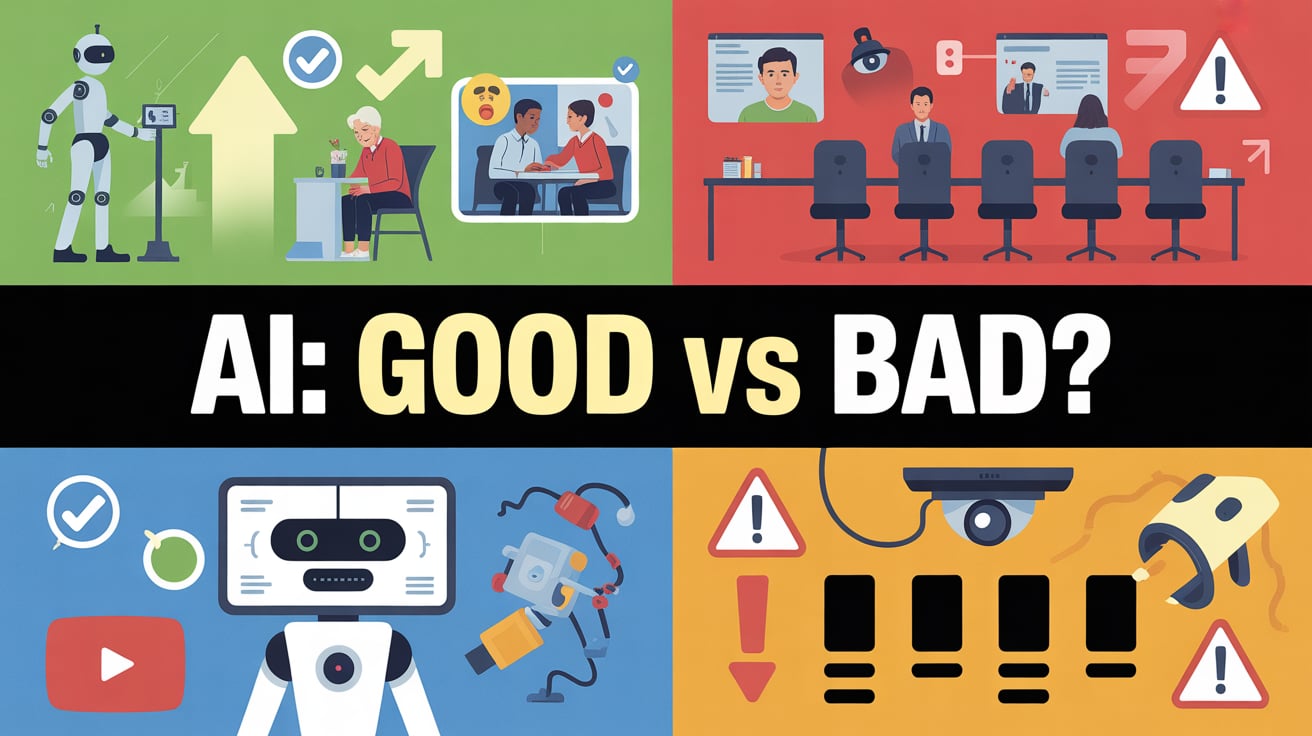
Artificial Intelligence has become one of the most influential technologies of the 21st century. The positive and negative impacts of artificial intelligence on society are widely debated because AI has the power to improve daily life while also introducing challenges that must be managed carefully. From smart devices and automated systems to healthcare innovations and autonomous machines, AI now affects nearly every domain.
To understand this transformation, it helps to explore the fundamentals. According to educational resources such as Wikipanda’s overview of Artificial Intelligence, AI refers to machines capable of performing tasks that traditionally required human intelligence, such as learning, reasoning, recognizing patterns, and solving problems.
This article provides a clear, detailed, and balanced explanation of how AI shapes modern society—both positively and negatively.
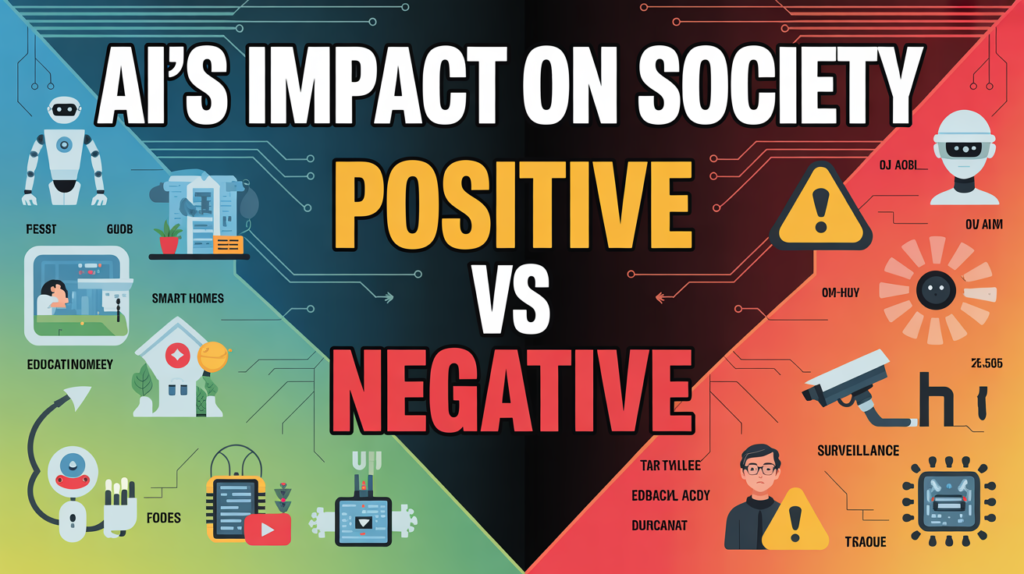
Key Takeaways
- AI increases efficiency, accuracy, and innovation across many fields.
- Automation and intelligent systems can disrupt job markets.
- Ethical concerns, privacy issues, and data misuse remain major challenges.
- Responsible development and transparent systems are essential for safe progress.
- Humans and AI together create stronger outcomes than either alone.
Introduction: The Growing Influence of AI
Artificial Intelligence has moved from academic laboratories into everyday life. It powers recommendation systems on social platforms, helps doctors detect diseases, supports businesses with data insights, and improves transportation safety through smart automation.
AI evolves through technologies such as machine learning, deep learning, neural networks, predictive models, and natural language processing. These innovations allow computers to understand human behaviour, analyse vast datasets, and generate decisions with speed that humans cannot match.
Because AI affects so many areas, its impact on society is complex. This article explores both sides with clarity, examples, and real-world context.
Positive Impacts of Artificial Intelligence on Society
AI contributes significantly to progress, productivity, and human wellbeing. Below are some of the most meaningful benefits.
1. Increased Productivity and Automation
Automation is one of AI’s biggest strengths. Intelligent systems handle repetitive or high-volume tasks, freeing people to focus on creative and strategic work.
Examples include:
- Chatbots responding to customer questions
- Automated email sorting
- Robots assembling products
- Software generating summaries and reports
- Intelligent scheduling tools
These systems work continuously, process large volumes of information, and reduce errors. Businesses benefit from smoother workflows and lower operational costs.
AI-driven automation also supports sectors such as logistics, finance, manufacturing, and customer service, helping organizations operate faster and more accurately.
2. Advancements in Healthcare
AI is transforming healthcare by improving diagnosis, treatment, and overall patient experience.
Some major contributions include:
- Detecting abnormalities in X-rays or MRI scans
- Predicting patient risks based on historical data
- Assisting doctors during surgeries
- Offering virtual health assistants
- Accelerating drug research
These technologies improve early detection, reduce workload on medical staff, and create more personalised treatment plans. Patients benefit from quicker diagnoses and more accurate care.
Healthcare systems also gain efficiency, which helps reduce costs and improve service quality.
3. Smarter Learning and Education
AI supports teachers and students by adapting learning materials to individual needs.
Examples:
- Adaptive learning platforms that modify lessons
- AI tutors providing instant explanations
- Tools that help students with disabilities
- Automated grading systems
Students enjoy more engaging learning environments, while educators save time on administrative tasks. AI also helps expand access to education by offering free or low-cost digital platforms.
4. Safer Transportation Systems
Smart transportation technologies use machine intelligence to analyse traffic patterns and enhance road safety.
Applications include:
- Autonomous driving systems
- Traffic optimisation platforms
- Driver assistance technologies
- Predictive maintenance for vehicles
These solutions reduce accidents, cut congestion, and support sustainable mobility. In the long run, they help build safer and greener cities.
5. Stronger Business Insights
Companies rely on AI to understand customer behaviour and market trends.
AI helps organisations:
- Analyse large datasets
- Identify patterns
- Forecast demand
- Detect fraud
- Improve customer satisfaction
By converting raw data into meaningful insights, businesses make better strategic decisions. This leads to growth, innovation, and competitive advantage.
6. Improved Security and Threat Detection
AI strengthens digital security by recognising unusual actions and stopping threats early.
Examples include:
- Monitoring financial transactions
- Detecting hacking attempts
- Identifying suspicious logins
- Blocking spam and malware
Because AI reacts instantly, it helps prevent losses and protects sensitive information.
Negative Impacts of Artificial Intelligence on Society
AI does not bring only benefits. Its rapid growth introduces risks and challenges that must be handled responsibly.
1. Job Displacement and Economic Challenges
Automation can replace jobs that involve routine tasks.
Industries at risk include:
- Manufacturing
- Retail
- Transportation
- Call centres
- Administrative roles
Workers may face unemployment or the need for new skills. Although new jobs will emerge, the transition can be difficult, especially for people without access to training.
Economic inequality may widen if opportunities are not distributed evenly.
2. Privacy Issues and Data Misuse
AI systems depend heavily on data. Collecting and processing huge amounts of personal information can lead to privacy violations.
Common concerns include:
- Tracking behaviour without permission
- Misuse of biometric data
- Profiling users
- Surveillance by governments or companies
People may lose control over their own digital identity.
3. Unreliable or Unfair Automated Decisions
When AI models learn from incomplete or biased data, their conclusions may be misleading.
Examples include:
- Incorrect identification in face recognition
- Unfair loan approval
- Flawed recruitment tools
- Misjudged risk evaluations
Such outcomes can harm individuals and damage trust in technology.
4. Cybersecurity Threats
AI can also be used for harmful purposes.
Risks include:
- Automated hacking attacks
- Creation of deepfake content
- Phishing campaigns
- Manipulation of social media
These threats can damage reputations, spread misinformation, or cause financial loss.
5. Social Isolation and Reduced Human Interaction
Heavy reliance on digital assistants and virtual tools may reduce human communication.
Possible consequences:
- More screen time
- Less emotional connection
- Weak social skills
- Reduced face-to-face conversations
AI can support humans, but overuse may impact relationships.
6. Dependence on Technology
When people rely too much on automation, their own skills may weaken.
Examples:
- Less problem-solving
- Fewer manual skills
- Reduced creativity
- Overconfidence in automated answers
Balance is essential to prevent overdependence.
Comparison Table: AI’s Benefits vs Challenges
| Positive Impacts | Negative Impacts |
|---|---|
| Higher efficiency | Job displacement |
| Better healthcare | Privacy risks |
| Improved education | Unfair automated decisions |
| Smarter transport | Cyber threats |
| Accurate business predictions | Social isolation |
| Stronger security | Over-dependence on technology |
How Society Can Balance AI’s Advantages and Risks
AI is powerful, but its effects depend on how we design, regulate, and use it.
1. Clear rules and guidelines
Governments and organisations should create transparent standards for AI development.
2. Protecting personal information
Strong privacy laws help individuals control their data.
3. Training and reskilling
People need opportunities to learn digital skills and adapt to new roles.
4. Human–AI collaboration
AI should support humans rather than replace them completely.
5. Public understanding
Educating people about AI helps reduce misinformation and encourages responsible use.
Future Outlook
AI will continue reshaping society in the coming decades.
Expect advancements such as:
- AI-assisted hospitals
- Smart cities
- Autonomous vehicles
- Highly personalised digital services
- Intelligent home automation
- New careers in machine learning, robotics, and data science
The direction AI takes depends on human choices, ethics, and governance.
Frequently Asked Questions (FAQs)
1. What is the biggest benefit of AI?
AI improves efficiency, accuracy, and speed across many sectors.
2. What are the most serious risks?
Job disruptions, privacy concerns, unfair automation, and misuse of intelligent systems.
3. Will AI replace humans completely?
No. AI will replace some tasks but create new opportunities as well.
4. Is AI safe?
AI is safe when used responsibly with proper oversight and regulations.
5. How can we reduce AI risks?
Through education, strong privacy laws, transparent systems, and human supervision.
Conclusion
The positive and negative impacts of artificial intelligence on society show that AI is both a powerful tool and a serious responsibility. It improves efficiency, strengthens healthcare, support education, and enhances safety. At the same time, it introduces risks such as job displacement, privacy invasion, and algorithmic errors.
AI’s future relies on responsible development, informed decision-making, and ethical oversight. When humans guide technology with wisdom and caution, AI becomes a force that empowers communities rather than divides them.